A dull ache at the back of the heel that gets worse the longer you are on your feet, or a stiff, sore tendon for the first few steps out of bed each morning, is one of the most common ways achilles tendonitis first shows up. It tends to build gradually rather than announce itself with one clear moment of injury, which is often what makes it confusing to work out on your own.This guide walks through what achilles tendonitis, also called achilles tendinitis or achilles tendinopathy, actually is, the causes and risk factors behind it, how to recognise the symptoms and tell them apart from other causes of heel and ankle pain, and when it is worth seeing a physiotherapist rather than waiting it out.
If your sore achilles tendon feels tender or swollen, or if achilles tendon pain when walking is starting to change how you move, the sections below will help you understand what is going on and what a sensible next step looks like.
What Is Achilles Tendonitis?
Your Achilles tendon is the thick band of tissue that joins your calf muscles to your heel bone, and it takes load every time you walk, run, climb stairs or push up onto your toes, as healthdirect explains. Achilles tendonitis describes pain and irritation in this tendon, and it is most often brought on by overuse rather than a single injury, developing gradually as the tendon is repeatedly stressed beyond what it can currently handle. Mayo Clinic describes it as typically caused by using it too much or too hard without enough rest.
It is a genuinely common presentation in both recreational and competitive sport. Better Health Channel notes that Achilles tendinopathy occurs when the Achilles tendon is stressed until it develops small tears and degeneration, and that runners appear to be the group most affected.
Achilles Tendonitis, Tendinitis or Tendinopathy: What’s the Difference?
All three terms describe pain in the same part of the body, but they are not strictly interchangeable, and the difference matters for how the condition is approached. “Tendinitis” technically means inflammation of the tendon, but ongoing Achilles pain is more often driven by the tendon’s fibres breaking down and disorganising rather than by inflammation alone. Sports Medicine Australia notes that the term tendinitis is inaccurate and may encourage people to seek passive treatments like rest, ice and anti-inflammatory medication, none of which are effective for this kind of tendon pain. Health professionals increasingly use achilles tendinopathy as the more accurate umbrella term, though achilles tendonitis and achilles tendinitis remain the names most people search for and use day to day, and all three are covered in this guide.
Why this matters practically: an approach built around rest and anti-inflammatories alone does not address what is actually driving the pain, which is one of the reasons a proper assessment is worth getting early rather than simply waiting for it to settle.
What Causes Achilles Tendonitis?
Achilles tendonitis develops when the tendon is placed under more load, more often, than it currently has the capacity to manage. A handful of factors commonly contribute:
- Overuse and a sudden increase in training load is the single biggest driver. Sports Medicine Australia points to a sudden change in activity, for example going from complete rest to starting a daily running program as the primary risk factor, and Mayo Clinic notes it often occurs in runners who have suddenly increased how hard or long they run.
- Footwear plays a part too. Mayo Clinic specifically flags running in worn-out shoes and running with poor form as risk factors, while Better Health Channel notes that wearing shoes with minimal support while walking or running, or wearing high heels, can increase the risk as well.
- Age-related tendon changes are a genuine factor. Achilles tendons naturally become less resilient over time, and Mayo Clinic states plainly that the Achilles tendon weakens with age, which can make it easier to injure, listing age itself as a risk factor for the condition.
- Other contributing factors include biomechanics such as flat or hyperpronated feet, tight calf muscles, carrying extra body weight, certain inflammatory conditions, and some antibiotic medications, all linked with a higher risk of Achilles tendon problems by Better Health Channel and Mayo Clinic.
What Does Achilles Tendonitis Feel Like?
Symptoms usually build gradually rather than appear overnight. The most common signs are pain and stiffness at the back of the heel or lower leg, particularly first thing in the morning or after a period of rest. Sports Medicine Australia describes this as morning pain and stiffness that worsens if you were more active the day before, which typically eases with gentle movement. As the tendon becomes more irritated, you may also notice swelling, tenderness and warmth of the Achilles tendon, and in some cases a thickened or knotted feel to the area.
In more persistent cases, pain that used to appear only during or after activity can start showing up during everyday movement, and Mayo Clinic notes that in more severe cases there might be pain even at rest.
Achilles Tendon Pain When Walking
Achilles tendon pain when walking is one of the more disruptive symptoms, because it affects something you cannot easily avoid doing. In general, gentle daily walking will not make achilles tendonitis worse, and staying appropriately active is usually more helpful than stopping altogether. That said, if the pain is sharp, is getting worse, or is changing the way you walk to avoid loading the tendon, that is a sign it is currently carrying more load than it can comfortably manage, and it is worth having assessed rather than pushing through it.
Achilles Tendonitis or Something Else?
Not all pain around the heel and ankle is achilles tendonitis, and it is worth knowing what else it could be before assuming. Pain that sits under the heel or through the arch, rather than at the back of the ankle, is more likely to be plantar fasciitis or another cause of heel pain than a tendon problem. Pain concentrated right where the tendon meets the heel bone, especially if it is aggravated by the back of a shoe, can point to a different issue at that specific attachment point rather than the mid-portion of the tendon.
The distinction that matters most is between achilles tendonitis and a torn achilles tendon or rupture, because the two are managed very differently. Achilles tendonitis builds up gradually over days or weeks. A rupture, by contrast, usually happens suddenly: healthdirect describes it as often coming with a sudden popping sensation, while Better Health Channel and Mayo Clinic both describe the sensation as similar to a strike to the back of your ankle, along with a sudden loss of strength that makes it hard to push off or rise up onto your toes. If that happens to you, it needs an urgent medical assessment rather than a routine physiotherapy appointment.
When to See a Physio for Achilles Tendonitis
Achilles tendon pain that does not settle within a few days, that is getting worse rather than better, or that is starting to change how you walk, train or get through your day is worth having properly assessed. Mayo Clinic’s general guidance is straightforward: if you have pain around the Achilles tendon that doesn’t go away, call your healthcare professional. If you experience the sudden, severe pain or loss of strength described above, that warrants urgent medical care the same day, not a routine booking.
A physiotherapy assessment exists to work out what is actually driving your particular case, rather than guessing from a symptom list. Your physiotherapist will look at your training history, footwear, movement patterns and calf strength alongside the tendon itself, then use that picture to build a plan specific to what is going on for you.
Treatment Options for Achilles Tendonitis
The reassuring part is that most Achilles tendon problems respond well to the right conservative management. healthdirect notes that most Achilles tendon injuries can be treated without surgery, and Better Health Channel is similarly clear that surgery is only recommended if all other treatment options have failed.
Current guidance from Sports Medicine Australia points away from a passive approach. It states there is no evidence to support the use of ice, crutches, medications or injections as a stand-alone fix, and instead emphasises addressing the load on the tendon directly, recommending you gradually increase the intensity and duration of your activity under appropriate guidance. In practice, that generally means:
- Identifying and adjusting whatever is currently overloading the tendon, whether that is training volume, footwear or movement pattern
- A structured, physiotherapist-guided program that progressively increases how much load the tendon is asked to manage over time, building its capacity back up rather than avoiding load altogether
- A staged return to the training, sport or activity that matters to you, guided by how the tendon is responding at each step
- Referral for imaging or a specialist opinion in the smaller number of cases that do not respond as expected to this approach
How Bounce Back Physio Supports Achilles Tendonitis Recovery
Getting achilles tendonitis properly assessed is the first step. One of our physiotherapists will examine your tendon, talk through your training and footwear history, and work out exactly what is contributing to your case, then build an individualised plan around that. Where it adds useful information, we also use objective testing tools such as ForceDecks and DynaMo to measure strength, power and load capacity in the affected leg, compare it against the uninjured side, and track how those measures change through your rehabilitation, rather than judging progress on symptoms alone. If you are managing the injury alongside an active sport or a return-to-play goal, our sports physiotherapy team has specific experience managing tendon injuries within a sporting context.
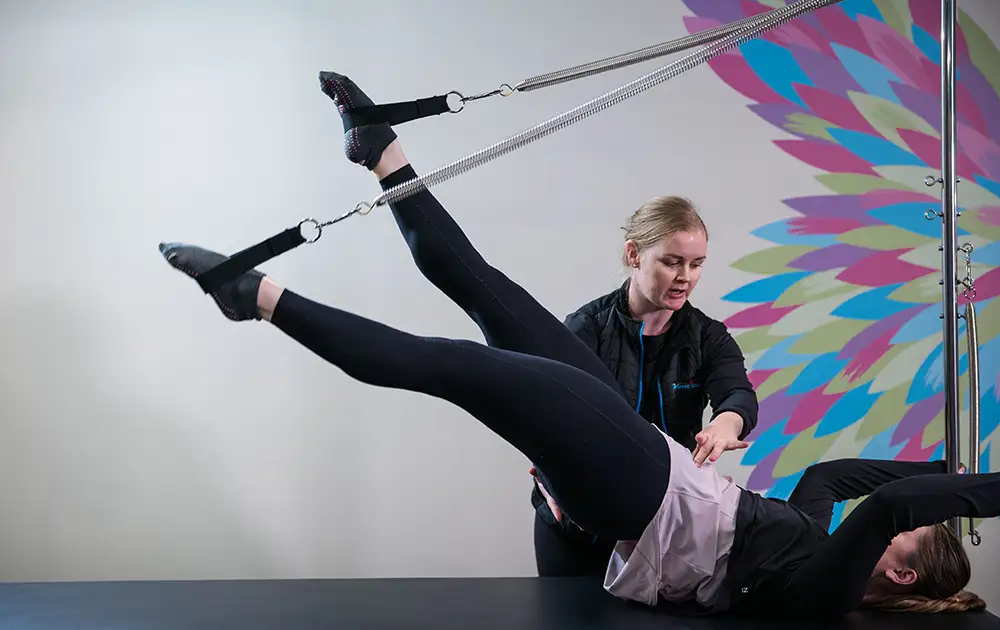
Once you are past the early, most irritable stage and ready to start rebuilding the tendon’s capacity, the Sports Injury Rehabilitation Program is where that progressively increasing load program happens. It is a small-group class held in our on-site gym in Narellan, supervised by physiotherapists and exercise physiologists, where every participant follows their own individualised program rather than a generic class routine. The group format is about supervision, coaching and accountability as you load the tendon back up, not a one-size-fits-all workout, and it is a well suited next step for tendinopathy conditions once your treating physio has you ready to progress.
Bounce Back Physio is based in Narellan, serving families and active people across the Macarthur region. Private health rebates are available: you pay in full at your appointment and claim your rebate directly through your fund. We also accept Medicare Chronic Disease Management plans with a GP referral, DVA with a referral, and WorkCover for approved claims, along with NDIS for self-managed and plan-managed participants.
If you recognise your own symptoms in this article, the most useful next step is an assessment rather than waiting to see if it settles on its own. Book an initial assessment online or call us on (02) 4648 1669 to talk it through first.
Frequently Asked Questions.
What helps Achilles tendonitis heal faster?
What helps Achilles tendonitis heal faster is addressing the load that is driving it, rather than relying on rest and hoping it settles by itself. A physiotherapy assessment identifies what is contributing, whether that is training load, footwear, calf strength or movement pattern, and builds a program that gradually rebuilds the tendon’s capacity, an approach Sports Medicine Australia favours over passive options like ice or medication alone. Recovery pace varies from person to person, so an assessment gives a far clearer picture than a general estimate.
Can I still walk if I have Achilles tendonitis?
You can usually still walk with Achilles tendonitis, and gentle daily movement will not usually make it worse. If achilles tendon pain when walking is sharp, getting worse, or changing how you walk to avoid it, that is a sign the tendon is currently under more load than it can manage, and it is worth having assessed rather than pushing through it.
What are the first signs of Achilles tendonitis?
The first signs of Achilles tendonitis are usually a mild ache or stiffness at the back of the heel or lower leg, often most noticeable first thing in the morning or after exercise. As it progresses, the tendon can become tender, swollen or warm to touch, and pain that once only showed up after activity can start appearing during everyday walking too.
What is the difference between Achilles tendonitis and a torn Achilles tendon?
The difference between Achilles tendonitis and a torn Achilles tendon comes down to how the pain develops. Achilles tendonitis usually builds gradually over days or weeks of overuse, while a tear or rupture typically causes sudden, severe pain, often described as a kick or strike to the back of the ankle, sometimes with an audible pop and a sudden loss of strength. A suspected tear needs urgent medical assessment rather than a routine physiotherapy appointment.
How long does Achilles tendonitis take to heal?
How long Achilles tendonitis takes to heal varies from person to person, depending on how long you have had symptoms, what is driving them, and how consistently a recovery program is followed. Rather than a fixed timeframe, progress is generally tracked against how the tendon responds as load is gradually increased, which is why an assessment and a plan built around your own tendon gives a clearer picture than a general estimate.
Do I need a scan for Achilles tendonitis?
You do not always need a scan for Achilles tendonitis, and it is often diagnosed through a physical examination alone, since a physiotherapist can recognise the typical pattern of tenderness, thickening and pain on loading without imaging. Better Health Channel notes that imaging tests such as ultrasound or MRI are sometimes used where the diagnosis is unclear or symptoms are not responding as expected.
Should I rest completely or keep moving with Achilles tendonitis?
You generally do not need to rest completely with Achilles tendonitis, and current guidance favours staying appropriately active over stopping altogether. Sports Medicine Australia points to limited evidence that ice, crutches, medication or injections address the underlying tendon changes on their own, and instead emphasises a gradually increasing loading program, which is best set and supervised by a physiotherapist for your specific case.
Ready to Get Your Achilles Tendon Looked At?
If you recognised your own symptoms anywhere in this article, the most useful next step is getting it properly assessed, not waiting another few weeks to see if it settles.
Bounce Back Physio’s team works from our clinic in Narellan, serving the Macarthur region, and includes physiotherapists experienced with sporting and overuse injuries as well as the Sports Injury Rehabilitation Program for when you are ready to rebuild load. Book an initial assessment online or call (02) 4648 1669 whenever suits you.